


According to statistics, 8 out of 10 people suffer from discomfort and pain in the spine.Although most do not believe that it can be associated with any pathology, attributing the reasons to characteristic inconveniences related to the course of life.
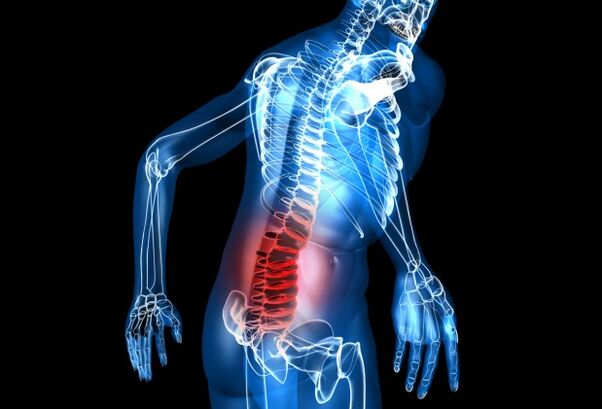
What is osteochondrosis?
Osteochondrosis is a degenerative dystrophic disease with complex cartilage damage in the spine.In cases of development, the process can spread to bone cells and tendons.Great stress on the spine can lead to the development of this disease.
Lumbar osteochondrosis occurs in the region of the coccyx, is of a short-term nature and has an acute painful effect.
Osteochondrosis of the lumbar spine
When diagnosed, lumbosacral osteochondrosis is defined as when the elasticity of the intervertebral discs is lost, the cartilage is worn and deformed.Ligaments and adjacent vertebrae also enter the process of deformation with time.Characteristic signs include limited movement due to back and leg pain.
Most often, such osteochondrosis manifests itself in the thoracic and cervical region due to the load on the sacrum and lower back.Such defects are possible with regular exercise and congenital specificity.
According to ICD-10, lumbosacral osteochondrosis has codes M42, M91-M93 - diseases of connective cells and has the following types:
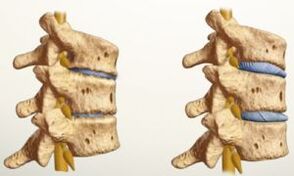 Polysegmental- it is considered a common and dangerous disease;pathological processes occur in several segments of the spine and in its different parts.If the lack of treatment leads to complications, it is necessary to diagnose and start treatment in time.
- Erosive- This is a progressive type of intervertebral disc damage with severe symptoms.The course of the disease is monitored by CT or X-ray.The main criterion is the preservation of sclerotic ring plates.
- Deformation- indicates a permanent joint pathology, in connection with which a degenerative inflammatory process develops.This process destroys the structure of the joints and leads to rapid aging.The cause of this pathology is excessive stress, although it may depend on other factors.
Treatment and rehabilitation
Drug treatment
In the treatment of the lumbar spine, chondroprotectors are mainly used, which are available in the form of tablets and solutions for injections.A regimen of several forms of medication is required for positive use.The use of injections takes place in a significantly short time, and it is considered painful due to the injection directly into the spine.
Also, these drugs have anti-inflammatory drugs and side effects such as nausea and rash.
In the treatment of the lumbar sacral part of the spine, non-steroidal drugs (NSAIDs) are used;they have an anti-inflammatory effect and indications for use in chronic forms and acute pain.
The joint intake of vitamins, chondroprotectors and glucosamine also promotes recovery.
Blockage for osteochondrosis
In case of severe pain that interferes with normal sleep, it is useddrug blockades.This treatment is used in all types of localization of osteochondrosis.
This application only temporarily relieves the pain;the medicine is injected through a puncture with a syringe in the spine.Commonly used therapeutic blocks are carried out with a strong pain reliever.
Physiotherapy methods
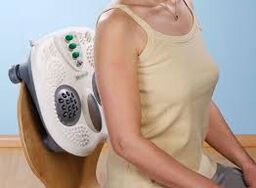
Physiotherapy treatment consists of reducing pain and inflammation:
- Vibration effect using vibration massageis the main method of physiotherapy.
- Ultrasound therapy is also used, enables the treatment of painful manifestations, has three factors that affect the body: thermal, physical-chemical, mechanical.
- Physiotherapy darsonvalIt is performed by supplying current to the skin through a vacuum electrode.With exposure to ionization with air, a weak electric discharge appears.With an increase in voltage and secondary air ionization, a stronger discharge occurs.
Massage
When the blood vessels of the spinal cord are compressed, asymmetry of the joint muscles occurs.In the area of deformation, compaction occurs, accompanied by spasms, pain and muscle tissue scars.
Massage promotes:
- reduction of pressure on the arteries of the nerve roots;
- spasms disappear;
- the activity of the vertebrae improves;
- blood circulation is normalized;
- tissue decomposition slows down;
- prevents the development of diseases;
- Prevents muscle atrophy and restores tone.
Improves general well-being of patients;in the early stages, with the use of massage in combination with other methods, the symptoms disappear.
Magnetotherapy
To eliminate the exacerbation of osteochondrosis, treatment with magnetic fields is used.This treatment relieves pain, normalizes blood circulation, relaxes muscles and improves the nutrition of the intervertebral discs.
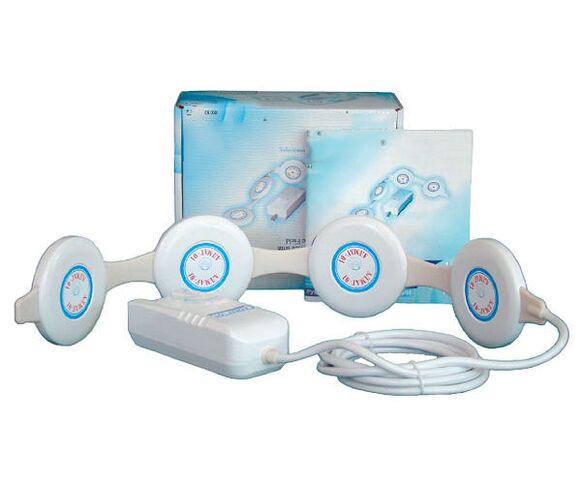
The procedure is used in exacerbations, as well as in all stages of the disease, using stationary devices, as well as portable devices, when used at home.
Manual therapy and acupuncture
The manual therapy method consists of jerking movements with the hands to restore mobility using different techniques:
- Manipulation techniqueinvolves dosed, slow stretching of the spinal joints coupled with a variety of bends and turns.
- Soft techniqueIt is thought to aim for relaxation to gradually reduce pain and relax the muscular corset.
The method of acupuncture therapy, based on the study of biological zones and the effect on them with needles, deserves special attention.It reduces the patient's need for anti-inflammatory and analgesic agents.
Therapeutic exercise
Participation in sports procedures for osteochondrosis is considered necessary, but taking into account all stages of the disease, you must carefully choose physical exercises:
- Exercises on simulators of vertebraepromotes the treatment of spinal curvature, scoliosis, kyphosis, disc herniation and strengthening of the muscular corset.
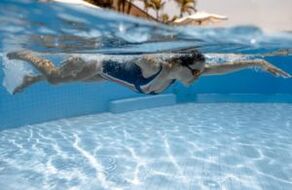
- Therapeutic exercises in the poollead to good results and are considered safe due to the absence of injuries.In 30-45 minutes of water procedures, complete muscle relaxation is achieved without much effort.Such activities help improve mood and normalize sleep.Swimming is also recommended by experts to strengthen the muscles of the lower back.
- Walking with osteochondrosisnecessary in this sense, Nordic walking is used, which experts recognize as effective.Due to the poles, the load is evenly distributed on the shoulder girdle and arms, which reduces the pressure on the joints and spine.
It is contraindicated to engage in any sports such as:
- Tennis.
- Throwing the disc.
- High jump.
- Frequent sports activities.
The same contraindications for osteochondrosis apply to:
- Intervertebral hernia in the lumbar region.
- In the phase of exacerbation.
Swimming lessons are possible with a doctor's permission or under the supervision of an instructor.
Exercises
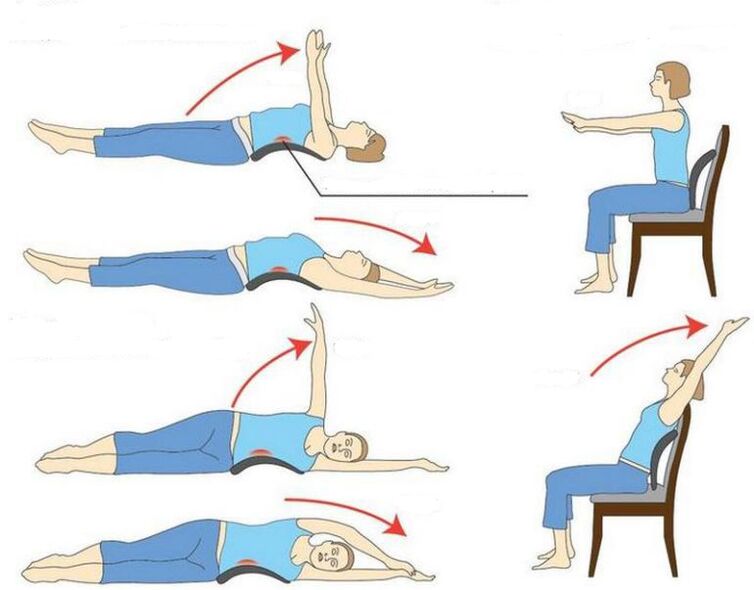
When performing therapeutic exercises, problem areas are subjected to stress in order not to cause damage and return them to their normal form:
- You must lie on a flat floor,Place one palm on your stomach and the other just above your chest.During a smooth inhale, the stomach should rise first, followed by the chest.Exhale slowly.It is necessary to repeat 10 times during the day, 4-3 times.
- Take a lying position and raise your headand the body, first put your hands in front of you, keep in this position for 1-2 minutes.Then slowly take the initial position, repeat the exercise 3-4 times a day.
- Unlock your upper back upwardsslowly bend the back of the chair while taking a deep breath.Then bend forward while exhaling and do this exercise 4-5 times.
- For the lower back- stand up, put your hands on your hips and slightly bend forward and back and to the side.Then make slow movements of the pelvis back and forth, repeat 10 times in each direction.
Yoga and Pilates
The use of yoga or pilates involves the smoothness and precision of one movement gradually transitioning into another.It is necessary to mentally monitor the condition of the muscles in each pose.
Deep breathing promotes a relaxing and calming effect;such exercises are similar to yoga:
- In a standing position, while inhaling, raise your arms above youand as you exhale, bend down on your right leg and touch it.Repeat the same action with an incline towards the left leg.In this case, keep your back straight;this is done for 2 minutes.
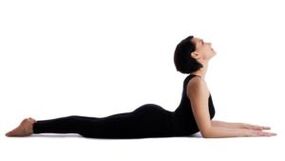
- Practice the cobra— lie on your chest, put your palms close together, rise on your hands while inhaling, first throw your head back.Keep your arms straight, breathing should be easy, chest open and stay in this position for 20 seconds.
- Turn your head left and rightsimultaneously hold for 10 seconds, then tilt your head down, trying to reach the jugular cavity with your chin, hold for a while, then tilt your head back and hold.Repeat the exercise for 5 minutes.
Orthopedic devices
Orthopedic devices for spinal correction are indicated for osteochondrosis:
- Orthopedic corset- it is used in the treatment of weakened muscles, it does not restrict movement and protects against displacement of the intervertebral discs, and it also serves to restore the spine.After the first application, thanks to the fixation, there is relief, spasm and pain subside.
- a pillow— reduces the load on the lumbar region by relieving the pelvic organs.The orthopedic device reduces pain, maintains muscle tone and reduces vibrations.There is another type of pillow designed for the cervical spine during sleep.
Dr. Bubnovski's original technique
Dr. Bubnovski's method can be applied by any person, regardless of profession and age.After the diagnosis, the doctor prescribes an individual method of treatment, taking into account the nature of the location and the pain.
Gymnastics with this method is performed independently or on multifunctional exercise equipment under the supervision of experts.This allows you to distribute the load specifically on specific muscle groups, while helping to relieve swelling, pain and cramping.
What can and cannot be done in osteochondrosis?
In order to avoid recurrence, people suffering from osteochondrosis try to use different treatment methods.In this case, you have to give up the usual things, but you can leave the heating in the bathroom.
The sauna promotes a good warm-up and stimulates physiological processes that reduce tension, swelling and pain.It is recommended to stay in the steam bath for no more than 10 minutes at a time and the same amount of break time.
You can also use:
- Massage.
- Yoga.
- Swimming.
- Sports.
What is not recommended for osteochondrosis:
- Lift weights.
- Overeat.
- Wear uncomfortable shoes.
Treatment with folk remedies at home
To treat osteochondrosis at home, you can use folk methods in combination with traditional treatment:
- Propolis- for this, it is necessary to roll it into a thin cake, cut it to the required size for application to the painful part.Attach it to this area and keep it for 1-2 days;the procedure takes place with a break of 12 hours until the pain completely disappears.
- Leeches— the essence of prevention is the relief of pain caused by the outflow of venous blood, which stagnates and causes inflammation.Leeches bite the skin of the affected area and suck blood, injecting Hirudin, which has a healing effect and improves the course of biochemical processes.
- Mumiyo— it is used in diseases of the musculoskeletal system, it has a stimulating, regenerative and anti-inflammatory effect.For osteochondrosis, compresses of 300 mg are used.Dissolve the mummy in a glass of water, then make compresses.
- Mustard plasters- they have medicinal warming properties.By dilating blood vessels, they have the ability to disperse blood, while increasing the supply of useful elements and oxygen.They also relieve pain and inflammation, improving the condition of the intervertebral discs.
Kuznetsov applicatorit has a fairly simple structure, involving plastic plates with spikes attached to a solid base.Depending on the basis of the pain, the applicator has a different shape: a flat mat, a roller or a belt with a buckle.
It also has additional devices with spikes and magnetic elements.The size of the spikes is from 2 to 5 mm, the average length is from 2 to 8 mm.
Prevention of lumbar osteochondrosis
Neurologists for acute osteochondrosis recommend swimming exclusively in swimming pools because there is a current in natural water bodies that increases the load on the spine.The water temperature should be 30 degrees, then it can be lowered to 23, and the swimming style is chosen depending on the disease.
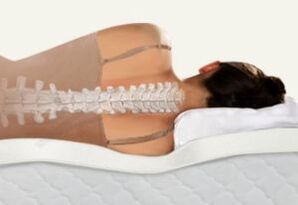
Also, in prevention, you must follow the rules of proper sleep, which include:
- choosing the right mattress;
- smooth base of medium hardness;
- Orthopedic pillows;
- proper nutrition, which includes food with vitamins C, PP, E, B3.
Rules for sitting - this requires a non-soft chair or stool, and body weight will not put pressure on the lower back.The body itself should be located on the ischial tuberosities, which is only possible on hard seats.
Sick leave - for osteochondrosis of the lumbar region
Sick leave and its duration depend on the complications and nature of the disease:
- Pain syndrome.
- Inactivity caused by illness.
- Working conditions and profession.
- Also from the treatment prescribed by the doctor.
- With radicular syndrome, it lasts up to 3 weeks.
- In case of complications, more than six months.
- Lumbar osteochondrosis - depends on the location, the severity of the pain syndrome depends on the complications and lasts at least a week.
In severe cases, hospital treatment is prescribed, after which the doctor recommends a change of occupation.